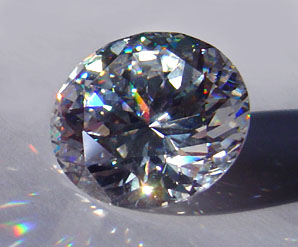
Note these are the same people who sell you your diamond engagement ring. Every woman who insists on a ring like this is starting your marriage on a lie. I got dragged into a store like this and paid thousands of dollars to a racist asshole who told me how much smarter we were than those Christianss who come in to buy jewelry for Christmas. I'll probably never really forgive my wife for doing that (but she is wonderful in so many way, just a victim of that propaganda like so many others), and God help me if my daughter doesn't know better by the time she grows up.
A friend of mine does jewelry courses in the Amsterdam area and has special courses for couples to make rings for each other. It's an order of magnitude cheaper than supporting the diamond industry, and much more personal and fun. His website is at http://sawugo.nl/ if anyone is interested.
My wife recently asked me "Why did we decide to get a diamond at all, when we both knew it was a scam?"
And I didn't really have a good answer. It just seemed like the thing to do at the time. We were both involved in picking out the rings, too; it's not like I went out and bought them for her without her input.
Thankfully I didn't spend a completely insane amount of money on the rings (not compared to what I was earning -- less than a couple weeks' wages -- which is still too much, really but not the crazy amount some people spend). But neither of us were really ready to step that far away from what was "expected" of us, I guess.
I had pretty much the same conversation, and also bought a ring that wasn't too expensive. I did feel a bit stupid for even spending that much once I saw AliExpress had a similar ring for $2:
I actually ordered one to see what it's like: The band looks exactly the same (I'm guessing it's just plated or a alloy though) and the fake diamond looks more shiny and isn't as heavy as it should be.
Wow indeed ! I had to dig some prices to see if that was indeed possible, especially with shipping. Made me realize the real value of $1 outside supermarket.
So, a top branded (Swarowsky) quality for a 1 ct equivalent CZ will run for $2, unbranded (AAAAA) for $1 and that's when you buy them by the unit.
Good quality (AAA) one bought wholesale will not go over 0.30$. That's still for good quality, if you cut down on quality price can drop much further (try ebay-ing). Note that AAA quality is what I buy for my coloured stones and they are IMO magnificent.
The material of the ring is silver plate, so that is basically worth nothing. Even if it was solid silver you would not have 1$ worth there, so $0.10 is probably generous.
2$ is probably 500% margin -at least- on the raw material (wow!) - I would not be surprised they didn't make 100% with manufacturing and shipping included. Impressive times to be alive.
You should the read the classic investigative piece on diamond trade and how the diamond ring was literally made into a luxury item. I am sure this has been linked from HN before, and believe it has at one point been a pretty active submission too.
Quote from the middle of the article: Since "young men buy over 90% of all engagement rings" it would be crucial to inculcate in them the idea that diamonds were a gift of love: the larger and finer the diamond, the greater the expression of love. Similarly, young women had to be encouraged to view diamonds as an integral part of any romantic courtship.
I faced a similar dilemma when purchasing my (now) wife's engagement ring. We were both familiar w/ the con, but she likes the traditional ring, so I wanted to find a diamond I could live with. Ended up with a vintage diamond ring from the 1940s (original papers and all). I was happy to avoid a greater contribution to the insanity of the diamond trade and my wife loved that the ring had a story stretching back a couple of decades.
I am not sure why you are being down voted as you make a good point. The only think I can add is most diamonds have a history that stretches back a few billion years. Diamonds are amazing things, but I am not sure if they should be linked to love.
My partner and I have been having an argument about rings for a long time now. I have told her that I'm willing to buy a man-made diamond, but she won't have any of it.
"I'd rather have nothing than a fake".
It doesn't matter how much information I provide her about the scam, it just upsets her. It's so very frustrating, and it's not entirely her fault. The idea is just so firmly implanted by the world.
Just make sure that the lack of rational thinking in this area isn't present elsewhere. It's innocent enough when it's about a random chunk of mineral, but gets more problematic when it's about eg vaccinating your children.
I'm always a bit surprised that HN doesn't get this. The rest f this point isn't aimed at you.
Just swallow your principles and buy the ring. It's a few thousand dollars amortised over the length of the marrage. Over seven years it's like $40 a month which for a lot of HN is pocket change.
She can point to a bunch of stuff that you buy which has inflated price that you rationalise away as useful spending -- coffee from a coffee shop is a scam yet people don't think twice about it.
Or, you know, don't compromise your principles to marry. Why give yourself almost certain cause for regret? Your trousers will cool off sooner or later. When they do, you'll see the matter much differently.
Sure, that's an option. A vegan should probably seek out another vegan to marry, rather than telling a meat-eater that she's wrong and has been conned by the system and that she's forcing you to buy some bullshit foodstuff that compromises your principles.
How is that equivalent? If I'm a vegan, I don't need to pressure others into my own belief system and expecting them not to eat animal food as well (I could, but I might as well not). Expecting your future spouse to buy a diamond that they think is an irrational purchase is by definition forcing your beliefs on others.
To be honest, so is not being willing to buy a diamond for your partner that wants it, but that's the point, find another person who agrees with your expectations of them.
I couldn't agree more. It might sound idealistic but I couldn't imagine being happy in a relationship where we don't agree on core principles (such as a stance on buying expensive diamonds).
Why would buying an expensive diamond be any different than buying a vintage car? Or really expensive speakers? Or any other toys the man will want?
I couldn't imagine being happy in a relationship without learning to compromise. Only the most important things should be considered "core principles", questions of religion, child-rearing, maybe hot-button political issues, and other moral litmus tests.
Whether or not she gets the ring she wants is a silly gender identity fixation, pretty harmless in comparison. If its a core principal, then so is whether or not he's allowed play video games, or buy a motorcycle, and so on. (Btw, I'm not engaged, married, nor ever bought a ring.)
The difference is expecting the other person to buy it for you. If a man expects the woman to buy him a vintage car or expensive speakers then it's the same thing.
I agree, compromise is incredibly important and it's all about finding someone whose core principles are the same as yours. For me, the thought of having a partner who would argue and resent me over me not buying an expensive diamond ring would suggest a clash in core principles. But I completely appreciate that that's my own view of it.
Just to be clear, this isn't (yet?) a make or break deal. We have a child together and have just entered into a mortgage.
I may change my mind to make her happy. She may change her mind because our financial situation has changed (mortgage). We may decide not to get married at all.
I don't consider this a core principle. Our views on the important stuff are very much aligned for the most part.
The vintage car is worth something should you want to sell it, it has some practical value if something happens to your normal car and you use it in a pinch and if you buy correctly a vintage car may rise in value over time. If you buy correctly you might be able to put 10,000 miles on a car and still see a year on year increase in its value( is it the 964RS that is currently hot in America ?)
This. Unless you can honestly tell me that you make no apparently irrational purchases. Coffee from Starbucks. Video games. Movies. I get it, you like them, they're convenient, and so they're rational purchases for you. But you can make better coffee for less money yourself, and you can be entertained for free. Compared to what you'll likely spend on these over the course of your life, compromising on a piece of jewelry your partner wants is nothing. If it makes them happy, be glad you were able to do that so easily.
If she wants to buy her own jewellery with her own money, that'd be similar to myself buying scam coffee. Unfortunately, that's not what is being proposed (heh).
it's more a matter of principle, whether you play along the con game like rest, or not.
and no, diamonds are not expression of love, will not make marriage stronger, last longer, don't bring anything close to real happiness etc.
> I have told her that I'm willing to buy a man-made diamond, but she won't have any of it.
Larger high grade colorless man-made diamonds aren't priced all that differently than wholesale natural diamonds and have the significant downside of having almost no resale value. Even if buyers pay 60% of wholesale for stones, it is still better than nothing.
Putting aside "fake" or not, unless you're buying colored diamonds, I don't see much point in buying lab made stones right now even if you're only concern is how pretty it is.
Tell me about it. Recently I've been trying so many different ways to come to talk about it and so far every one conversation ended up with her being in tears and not being able (probably not willing) to understand what I'm saying. She just sees me as a sales person trying to sell her some scam.
Now I'm betting on time, from time to time just constantly reminding her of whole rings scheme and why we shouldn't be bothered with that and should stick with a simple/traditional wedding rings.
She wants a ring. She doesn't care that you think it's a scam. What she knows is that you won't buy her a ring. You think so little of her that you won't buy her this gift.
You refuse to compromise; you refuse to budge; you refuse to accommodate her wish. You make her be for this gift, and you still deny her.
You even made her cry, and you post here almost proud of bringing someone to tears because you refuse to see things from her point of view?
I see what you mean and I agree that from her point of view this might look like I don't care about her. At least not enough to bend my principles. But on the other hand, I have mentioned this on the day I've met her first time, obviously she didn't think much of it back then.
I'm happy, not proud. I'm happy, because I'm not alone who's thinking this way. Believe it or not, there isn't a lot of people that agrees with me.
>> She just sees me as a sales person trying to sell her some scam.
This is where you are mistaken, to her it's not just a ring, or a scam. It's her as a little girl dreaming and looking at the engagement rings of other women, imagining the day she'll be able to 'show off' one of her own. Sad to say, but in our culture, this stuff means a lot.
That's exactly her argument. She has dreamed of it since she was a little girl and she just could not accept the fact that maybe, just maybe, the dream was false.
Why can one sex indulge in their childhood fantasy but the other cannot? If a guy saves for a car he has always wanted, something he saw years ago as a teen or whatever he is said to be having a midlife crisis whereas buying a lump of carbon/gold is seen as a beautiful tradition?
I think the tradition is that a man should invest a certain amount of resources. And the point is to not buy/get anything useful. A pile of money for a diamond ring is some resources.
Well, if you are moderately progressive, you still want to be sexists and follow tradition, but you don't wank to sink money in diamonds. I just wanted to say there are alternatives.
You can still get an awesome engagement ring for, let's say, $500, with no diamond, just a nice blue aquamarine or some other wonderful gemstone. Something that goes well with her eyes.
Lay it on thick. Put in a lot of effort to have it custom made. Involve her in the customizing and decision making.
But stick to your guns on the diamond. It's simply not cool.
Or find one on Craigslist but please don't buy one from a jewelry store if you can help it.
Some unsolicited advice: Tell her it's not about the money. Tell her you want to spend it on something useful (like a future child's savings account) or fun (like a trip for two around the world) but not on a piece of jewellery.
Humans like rituals for the important moments in their lives. Buying a ring is one of many rituals around weddings, but for a lot of people, there's something viscerally satisfying about marking events ritually.
I don't think it's complete nonsense - buying something useless and expensive is a very strong signal (like the peacocks tail). Buying something useful for the money instead is not the same thing at all.
So while the diamond thing was created through advertising, it persists because it has a real function. Maybe it could be replaced by something else, but that would probably be something just as useless to demonstrate commitment.
Still, if you can get by without the investment, good for you.
> ...buying something useless and expensive is a very strong signal...
I see this comment every time engagement rings come up on Hacker News. Yes, it's a strong signal. But we're a bit smarter than that, and we can select mates who are smarter than that too. Perhaps this kind of peacocking will die out. Perhaps nature will select for mates who are level-headed enough to look at salary figures rather than shiny rocks. There are going to be a lot of people who realize that a down payment on a house or money in the bank will make their relationship more successful than a shiny rock will. I'm willing to bet on those people living and reproducing.
Right... but humans have a much richer way of signaling than most animals. My point is that some humans will find ways to signal commitment without sinking three months of their salary into a worthless rock. Signalling theory is an explanation for observed behavior, not a guarantee that such behavior will persist if the organisms in question develop alternative strategies.
I like to think humans are pretty good at developing alternative strategies.
Besides, if you get divorced, you don't get your down payment back anyway.
Sure, as I said in another comment, diamonds could probably be replaced. But it would probably be by something just as useless.
Or maybe if you can find a way to mimic the effect, but make it useful, you have your hands on a very valuable startup idea.
I guess it would be something like helping friends move, which is considered a good signal for true friendship. I don't know (not an expert on this), maybe if you find a way to "help your spouse move" for the equivalent worth of 3 months of your salary, you are good.
Why don't you get your down payment back if you get divorced?
The point is, changing spouses is expensive if they all want a diamond ring. So that custom is a shield against heavy spouse changing.
The whole marriage thing is also extremely expensive. I suspect for similar reasons - so that people think twice before throwing it away. In that case they also have angry friends and relatives who invested into expensive travel and presents and probably wouldn't be too happy if it was all for nothing.
There are only a few outliers, by definition. So most people have to make the compromise. Coordination games work by punishing you when you don't follow the crowd.
I would rather take out a few thousand dollars in cash and burn it in front of her than spend them on a diamond. That also has the added benefit of reducing inflation.
So how about donating to some charity? The wives can then talk about that... "My husband donated thirty thousand to a school in africa". Or is it harder to show than a diamond?
The problem is that the husband in your example might have liked to donate to charity anyway. It would have to be something the husband doesn't give a shit about or even actively dislikes spending money on.
Also it's harder to show off reliably.
The ring is in many ways pretty good: It's always on your body, in direct view of your peers and it had absolutely no utility to the buyer except as a gift for the receiver.
Maybe there's a market for "ethical rings" that work as a token / certificate of a donation. For example restaurants like to show all kinds of diplomas on the wall at least around here.
So she should pick the charity. I'm sure it's easy to find ones which the husband would not have donated to on their own.
Classification societies already by the way have established ways to do development aid verification.
On the other hand, just withdrawing the amount in cash and setting it on fire might cause less harm to the world than a blood diamond. What a bachelorette party... :)
I thought expensive jewellery was meant as a sort of life insurance policy. ie the widow could sell it in the event of the husband's death and have enough to support her for a period of mourning. Or something like that.
Historically it replaced suing the other party in a failed engagement for "breach of contract". The idea being that a woman who had a failed engagement was less able to find a good match. The engagement ring essentially acted as a good behaviour bond that the marriage would go ahead and especially to stop the "I promise I'll marry you, now let's have sex" cad.
>buying something useless and expensive is a very strong signal (like the peacocks tail)
And how did it help the peacocks to feed itself or outrun a panther? You will say "but the ultimate goal was to transfer his genes and he did". Yeah OK, so the ring is a lie and probably first bad financial decision in a future long strike of bad ones that help dudes to get laid and then get trapped in the rat race pay check to pay check.
The point of signalling is to prove fitness - the peacock can afford to carry around a huge tail because he is fit enough. Women walking on high heels PROVE physical fitness. The point is to create a signal that is hard to fake.
Putting money into a down payment for a house doesn't signal commitment or financial strength. You would have had to pay for housing anyway. Throwing away x times your monthly salary shows commitment and financial strength.
Financial security is obviously important, and I might be in a minority here, but I'd like to think that financial strength isn't a good basis for choosing a partner. Depends what you want out of a relationship I guess.
Financial issues ruin marriages, moreso even than infidelity. "Richer or poorer" is the bit of the vow that might seem easy when you're young, in love and likely to get richer, but if a financial crisis destroys your social circle, uproots your children and severly challenges your lifestyle then it becomes very hard to overlook.
I'd also observe that "ability to live within ones means" is not necessarily a "richer or poorer" thing. There are those who will always live within, say, 80% of their free income until you literally hit the bottom where you can no longer survive, and there are those who will always live within 125% of their income, even if you give them a 25% raise every single year of their life. The first of these is marriable, the second effectively isn't.
(Note my complete lack mention of any gender whatsoever, or any other characteristics. Regardless of what the population statistics may be based on any traits a person may have, what matters is whether this person standing in front of you can live within their means, and anyone has the capacity to pass or fail this test.)
I agree that this is what can be observed, although it's probably a lot more complex than "being rich = beautiful partner". Either way that's why I said I'm probably in a minority in considering it less important than other traits (such as honesty and kindness).
That you think most women need some sort of extravagant and useless signal of a man's commitment to them, and that this is in your mind a uni-directional thing.
But why not signal with something that has "real" value, e.g. a golden/platinum ring (that you can actually resell for it's weight in gold)? Same signalling, same expense, but better investment.
"Most of us are way above the peacocks, intellectually."
Lol - not really. Lots of signalling going on among humans. I mentioned the high heels, but I think most womanly things are like that: long hair and long fingernails show not having to work (manually), so high status.
Even drinking and smoking could be part of the game (showing off that you are healthy enough to cope with a little poison). Many, many things - signalling theory is essential to understanding our society.
What is useless about something that is beautiful? Many people purchase objects of beauty (just look at the art world!) which cost much more than a diamond!
The fact that you're paying radically more than any actual open market price that you could possibly access.
If you paid $10,000 for something but could generally resell it for something like that value it wouldn't be a scam. But if you buy a $10,000 ring from a vendor and try to find a way to sell it for anything like that much, you will find you can not, and not only the usual "I can't recover the vendor guarantee and reputation premium" that you'll find if you try to sell things on Craigslist or something, but you'll find that you can't even come close.
It might be tempting to get into philosophical discussions about "what is value, really?", but that would be the wrong direction to go here. I'm happy to take value as a highly subjective judgment, because that is indeed what it is. My point here is brutally practical, and, well, exactly what I said, and no more... the problem here is literally that you will find that what you've bought can't be resold for anything like what you bought it for, and where that truth comes from doesn't much matter when you're trying to resell.
The art world is radically different. It is assumed that you are a smart consumer who is expected to defend themselves. And I'd also point out that if you spend a million dollars on something that turns out to be a really high quality forgery worth about $5K on the open market, we still call that a scam.
> the problem here is literally that you will find that what you've bought can't be resold for anything like what you bought it for,
What does this have to do with an "open market price"? Most anything bought at retail price will not have the same resale value, that's just how resale markets work. They buy at wholesale and sell at retail. Pieces of jewelry and whatnot are not commodity bundles you can trade on a liquid market.
Retail art pieces aren't any different.. High dollar art trades at auctions (again, lots of liquidity), that's why they're easier to resell. But if you sink five grand into a piece from some gallery, good luck reselling it.
As I said in my message, I covered that with the "retailer premium", which I understand exists for a reason, which I describe. That reason does not cover the degree to which you can not resell the ring, which is absurdly large. Also observe that despite technology recently being able to make "forgeries" ever better, this inability to resell at anything like what you paid for it has been true for decades.
Maybe because the demand for rings is not for their commodity value, but for their signaling value? So buying a ring from Tiffany's is worth a lot more than buying one off craiglist? And they aren't scarce so jewelers don't need to snatch them up off the "open market", but they need to make high margins to cover the overhead of their fancy stores.
Are you looking for a cause to the "absurdly large" degree? Or just pointing it out as some mysterious conspiracy?
Of course you can't get full retail value when reselling a luxury good. That's as true of Tiffany rings as it is of Macbooks.
But there is a conspiracy to exploit people desperate enough to have to liquidate their jewelry. It's detailed in the article linked to by the OP. That conspiracy is what causes jewelry to have a resale value of maybe 20%. Compare this to 6-month old MacBooks Air (worth ~80% of their retail price) or a car you drive off the dealer's lot (worth ~80% of what you paid).
Gold, silver, and diamonds are quite literally valued by an open market. You can call a broker and buy them for what the whole world has agreed is a fair price.
A piece of jewelry's wholesale value is determined by adding up the market value of its constituent components and then adding a workmanship premium. In an ideal world, consumers could buy and sell jewelry in the same way.
This is interesting, but I guess I'm wondering how it really differs to buying a brand new car. The moment you drive it outside the car dealer you've lost money. It would be interesting to compare the lost value of jewelry as a percentage to other items purchased brand new.
The diamond I have was purchased at wholesale price and custom made into a setting - it wasn't some off the shelf piece from Tiffany's. I think that where you purchase the jewelery from can also make a significant difference to its resale value.
"This is interesting, but I guess I'm wondering how it really differs to buying a brand new car. The moment you drive it outside the car dealer you've lost money."
A: Nowhere near as much, and B: That's what I was referring to with the "vendor guarantee"... the reason why your car loses its value when you drive it off the lot is obviously not that the car changes meaningfully, but that in the somewhat scammy world of used cars you will not be able to establish to anyone that your car really is brand new anymore, so you take a hit based on the fact that you do not have a reputation that says "I am $CAR Dealership XYZ and I stake my name on the fact this really is a brand new $CAR straight from the factory".
(Incidentally, to some extent, note that when people suggest that the solution is to always buy used, they often aren't taking that into account properly in their zeal to make their point. You're paying less precisely because the odds of you being scammed just went up. If you are, for instance, someone very likely to be able to detect scams, by all means, go collect your "knowledge premium" from the market and buy used. But if you are not such a person, think twice. I don't mean "never do it"... I just mean, think twice. I have family that was taken for a ride by buying used when they "couldn't afford" new... well, it turns out they couldn't afford "scammy used" either....)
Yes, that is one solution to the conundrum, buy at actual market value. In the longterm that's an unstable solution... if rings lose their signaling value entirely (see other comments), then the eventual stable solution is not to buy them at all. However, in the meantime, what the eventual stable solution 50 years from now will be isn't actionable today, so by all means buy something that impresses your friends and pocket the difference. My wife and I went a different route and bought a nice ring with two Tanzenite stones in it for, IIRC, on the order of $250 1999-dollars, and I still think it looks pretty nice. Tanzenite is a bit soft but we've had no problems, and I think it's beautiful but the jewelry community seems to think it isn't worth much. We were happy to come to arrangements with them on that matter. This is another way to hack the process, since people aren't consciously thinking all the way through this it can suffice to present a token similar to a "diamond ring" but that did not require the useless investment.
But the jewelry doesn't even have to be used. It loses value /when you buy it/, wherein lies the scam. If you buy a car and don't start up the engine and try to sell it a week after you bought it it will be worth approximately the same as when you bought it.
Good luck if you're not a car salesman. It's a reputation issue, why should I trust you that there isn't a problem with the car, why are you selling it? That "risk of it being a lemon" factor is what causes a new car to massively depreciate.
But why is it beautiful? A CZ is indistinguishable from a diamond until you look at it with a microscope, yet maligned as an inferior piece of jewellery.
High quality diamonds look grayer/silvery under bright light, whereas CZ produces rainbows. I own both, and it's easy to tell the difference if you're, say, outdoors in the summer, or under full-spectrum lighting. Moissanite is closer, but moissanite still has more of a "rainbow" look, and is often yellowish.
If a friend of mine was showing off her engagement ring and it was refracting a little rainbow on her finger in the sun (like this http://upload.wikimedia.org/wikipedia/commons/b/bd/CZ_brilli...) I obviously wouldn't say anything, but come on. Getting a CZ engagement ring is going to lead to an awkward situation at some point.
There are a few quick tests that can quickly separate a CZ from a diamond. Exhale on a similar diamond and it clears up much faster because of diamonds high thermal conductivity.
More importantly, CZ is far less though than diamonds so they don't keep their shape under abuse nearly as well. There cheap enough you could swap out the stone every year, but just keeping the same CZ in a ring does not work over a lifetime.
I'd rather buy her a car, even if it is 2x, 3x more expensive than a ring. At least it has some utility and it definitely has a wow factor to impress her friends with.
The expected lifecycle for a ring can span generations (or used to, at least). A car will last you a decade and you'll be eyeing others in half that time.
If this kind of gift is made to be symbolic of your relationship, then a car (or any other heavily depreciating asset) isn't the best symbol.
One of my friends got an olive tree for her 25th wedding anniversary. I thought that was a great gift.
The expected lifecycle of an engagement ring is one engagement. Getting her something "used" would be even worse than something "fake".
And diamonds are a heavily depreciating asset. A car loses about 10% of its value the second you sign the purchase contract. With a diamond ring, it's more like 60%.
Obligatory plug for titanium / non-precious rings. My Ti band was $20 on Amazon, and on the other side of the spectrum, my wife had a beautiful Ti ring, including a tension-set lab-grown sapphire, milled to her specifications for < $500. But not conforming in this small yet significant way takes a certain kind of person.
Solid silver wedding bands reporting in. No stones. We have two pair. We've travelled a bit and never been afraid of being mugged for our jewellery. Cost was cheap enough that I can't even remember. Very happy that we weren't hoodwinked into giving large sums away to diamond retailers.
The only problem with Ti rings is that if you run into an accident where the ring needs to be cut off it’s almost impossible for standard hospital equipment to do it.
It's true that Ti rings are harder to cut, but the equipment to cut them is standard in American ERs. It still takes longer though. Even worse are the newer cobalt chrome rings, those take forever to cut off even with the right equipment. Safest of the alternative materials is probably the tungsten carbide or ceramic rings, since those can be fractured off with a pair of common vice grips. Don't know what happens when you're traveling in an area with a less developed medical system. If you aren't at risk for anaphylactic swelling, don't work with your hands, and don't travel in undeveloped areas, the risk of this sort of situation might be low enough to not worry too much about.
A more practical problem with alternative materials is that they can't be resized (some jewelers will resize Ti a little, but it's challenging). The alternative materials are cheap enough that you can buy a replacement that's the right size, but if you're sentimental (and a wedding band seems like something one might be sentimental about) it's a problem.
There's nothing wrong with alternative materials, it's just that sometimes the drawbacks are overlooked while being dazzled by the advantages.
The equipment is not expensive for hospitals, under $500 for everything. Most have tools like these to take off rings of all sorts of materials. Many Ambulances even carry them now.
I love my engagement ring, sure it's not practical and we'll never get the money back that was paid for it. Every time I look at it sparkling, I think about my husband, and I think about the rock itself, where it came from, how it was formed, how old it is, and it makes me really happy.
We aren't short of money so the purchase of the ring wasn't a big deal - we would easily spend twice the amount of the ring's value on travel every year.
The ring is diamond and platinum and it's very strong - I've smashed it against all sorts of things, gone canyoning, scuba diving, you name it, and the platinum is barely scratched.
We plan to keep this ring in the family and pass it down through the generations. The sentimentality and 'family heirloom' qualities are also really appealing to us.
I'd much prefer this ring than a rolex, or a gold Apple iPhone for that matter!
"I think about the rock itself, where it came from, how it was formed, how old it is, and it makes me really happy"
While you're thinking, think about how it was mined and trafficked, and try to estimate the amount of blood it took to get it on your ring... It's maybe none, but you'll never know for sure...
A Rolex at least is made by skilled and respected craftsmen, rough diamonds are often the product of war and slavery...
So I bought such a ring for my ex-fiancee, and have been halfheartedly trying to sell it for... a year? two?
I understand I got ripped off at the point of sale (that's just how it works), but as per this article, I could very easily get ripped off selling it back.
Unfortunately I really have no idea how to get rid of it and get a reasonable value for it - or what that value is.
You will get the most money selling it yourself through eBay or exboyfriendjewelry or local buyer etc. Your second best will be to put the ring on consignment at a good local mom and pop jewelry store. After that the value drops dramatically.
The markup on diamonds has dropped dramatically since the internet started making them a commodity. What used to be a 4x to 5x markup is now 2x. If you think 2x is high, look at Starbucks. The design, the art, the emotion has zero value.
If you decide to sell look at price listings at a site like Pricescope to see what new, unset, diamonds are selling for at bottom retail. If you can get 40% of that you are doing great because the seller is already buying at 50% to 60% of that price so anything more than 40% means it would be easier to just buy from his normal supplier rather than deal with an off the street buy.
Diamonds and jewelry are NOT investments. They are luxury items. Very very few things maintain their value once you walk out of the store with them. Cars, boats, airplanes and so on. Luxury items. To think you can sell it back for anywhere near what you paid is unrealistic to begin with. And one last thing. If anyone that tells you a diamond is an investment, run.
Keep it. You're likely to sell it for quite a loss. If you think you're likely to find a partner again, you'll be in for buying one again. Diamonds are /forever/ (:P), keep and reuse it.
I was once present for a very awkward conversation where a husband told us that his wife's ring was second hand in front of her and she was shocked. He thought she knew him well enough to know that he'd never buy one first hand...
First Post. I'm just curious how you guys think about a ring made of gold or silver. I remember my parents didn't buy a diamond ring. I know you need to be careful when buying gold and silver too and always have a look at the spot price, but a gold ring would have some resell value right?
Another reason not to support the diamond business is how blood diamonds are mined.
I sold a 14k gold engagement ring once and the jeweler didn't care about the diamonds at all, and only was interested in the melt value of the gold. I still have the diamonds because he was literally going to give $0 for them. Unless they are quite large or a rare color etc, I don't think they have much resale value. At a reputable jeweler however you should be able to get 80% or more of the spot price.
The markup on a regular piece of gold jewellery is 300 to 500% depending on the brand. Much more if the piece is complex and handmade or very small. That does not make sense to buy it as an investment.
300% is not unusual for a product when you consider everything between the raw material and the finished piece in a shop. For example, even for handmade piece, the jeweller will not start from raw gold, but from sheet or wire. The markup on those, out of the refinery is already 20 to 50% and he has not even started yet.
Jewellery has as much use as any other decorative item, buy them as such. You like the craft involved in making it, go to an artist a see him working days on your commissioned( * ) piece for an insane amount of money. You don't care about the craft, just like the look - go for the cheapest possible that look good ( base metal plated, synthetic stones, machine made, ... )
Avoid anything in between IMO, to much of the value there comes from decades of marketing campaigns. If you like them anyway, go to auction ( not ebay, too expensive ) or second hand.
( * ) note that picking a stone and choosing a mount is not a commissioned piece - the jeweler will probably spend less than 1 hour working on your ring, half of that polishing it. It means going to an artist and picking a custom one of a kind design, with the majority of the work done by hand. i.e. Same difference between buying a limited print of a famous painting or go to a painter to have your family painted. Despite being the same price, only one is making an actual artist live.
There are a staggering number of honest jewelers and gold buyers out there. But stories about obviously crooked people are what makes everyone say "see, these guys are ALL crooks". Just because he did this in his brother's store and it is his only experience, doesn't mean that all places are like that. And yes, I spent a decade working in a high jewelry store. If anyone did anything like this they would have met the front door so fast they wouldn't even realize they had been fired until they were in the parking lot.
Thanks for pointing that out. I've bought and sold enough gold and silver to know that what you're saying is true. Also most of the customers I've seen are quite savvy, and know exactly what they're doing. Occasionally a frazzled soon-to-be-divorcee is in their ready to fire sell her ring, but not a majority from what I've seen.
On the other hand I've been told "diamonds are forever" is an inside joke that means you better keep it forever because you'll never get back what you paid for it... is that true?
Kind of like how most in the U.S. actually pay all their taxes as required without cheating, but we all hear about those few that cheat and so assume we're the only ones playing fairly.
I had a similar beliefs about diamonds and wasn't really sure how to talk about this to my (then) girlfriend. She's very progressive and would not interpret what I was saying as being a cheapskate (I'm the spendy one), but it seemed like the whole 'actual' value / marketing / cartel / theoretical human rights angles were all very rationally convincing, but pale in comparison to the cultural significance and century of visceral marketing. To compete on an emotional level it would mean watching blood diamond movies and/or being exposed to diamond industry scumbags for long periods of time. Not really how I wanted to start discussing a 'symbol of our love', and I didn't really want to be that guy.
So I just stated that I wanted any future theoretical ring to have real significance, not just a purchase. I preferred there to be some history behind it. This opened a door to rework a family heirloom (with a great story) into an engagement ring. It happened to be a diamond, but this process was so much better than diamond shopping that I'm pretty sure if it had been a sapphire it would have done the trick.
She was already on board with the "no blood diamonds" angle. We ended up with a "Hearts on Fire"[1] diamond, which claimed at least to have a paper trail proving that it did not come from a war zone.
It also had the advantage of a shallower cut that made it look larger than a normal cut on a stone of that carat weight, which also reduced the total cost.
I do like your idea, though. It's a bit late to be useful for me, though. ;)
Not sure if that's the best way to look at it. You bought your wife the ring as a token of your everlasting devotion to her - there's a certain poetic quality to that token being made of the hardest substance on Earth.
You didn't buy the ring as an investment, I mean what are you going to do, take the ring back and sell it when the market is more favourable? Any profit you make will be quickly swallowed up by the divorce.
Just like the gold Apple iPhone, or other luxury items, those who can afford such things will create the market for it. I don't see how diamonds are any different to other luxury goods.
Let those who can afford it buy it, I'm sure it gives pleasure to many people. It's also a status symbol - just like cars, luxury watches, handbags etc.
When my wife and I got married 25 years ago we were broke - I was studying for a PhD and she was about to go to law school - so no expensive rings for us.
However, what she does is buy a new inexpensive ring every so often and designate that ring her engagement/wedding ring. Recently she bought a ring with quite a large stone and she has been deeply amused that everyone thinks it a real diamond when it probably cost less than £50.
Haha, grow up. Useless to him !== useless to her. Marriage is dependent on compromise and negotiation, among other things. The world is chock-full of nonsense, and you will have to navigate it, whether you do so single or married.
Good grief, I don't think I've ever seen so much bad dating advice in one place as the comments in this thread, lol.
You have to navigate it. You don't have to surrender to it.
Much of that nonsense persists solely because so few possess the fortitude to resist it.
If your spouse insists upon a diamond, you may compromise, but also negotiate something of equal value to you. Perhaps, in exchange, you get sole authority to furnish and decorate the living room in any shared domicile, guaranteed.
You could install an octopus tank. You could put footballs on doilies on cinder blocks. You could create your own Batcave, Starfleet bridge, or Vault-Tec bunker. You could cover the walls in deep-pile maroon shag carpet. You could install 31.1 surround sound, using 24K gold Monster cables insulated with albino alpaca wool braids.
If the ring is a signal to your spouse's social circle that you are the best partner, so too is having all that embarrassing decor connected to the front door of the house, rather than hidden away in the basement.
If you have any inkling that particular compromise may be stupid and selfish, and not useful at all to the marriage as a whole, don't ask for a diamond ring.
A diamond is not forever. A 1:1-scale replica of the TARDIS in your living room is forever. If you burn a significant fraction of the family resources on a useless toy just for you, your spouse will be entirely justified in spending an equal amount on pointless toys just for them. And you can get a lot of pointless toys for the price of one ring--some of them will even yield a higher resale price.
If you don't want your marriage to be stupid and wasteful, you have to set a higher standard right from the start.
This is one of the reasons why poor people stay poor, because they typically have a wildly disproportionate value of their household's portfolio in jewelry or gold (+), often explicitly because of the ability to use it as savings or collateral. It happens to be an abominably bad vehicle for both.
+ I'm trying to find the citation but I think the average value in the US for households in the lowest wealth quintile is > 25% of their assets.
Poor people stay poor because there are so many systems in place that squeeze them, from usurious payday/title loan shops to rent-to-own places; and the stuff poor people buy is never built to last. There's something to the Vimes theory of socioeconomic unfairness.
The people who run these systems have free reign to squeeze the poor because the poor have virtually no political power. (When was the last time you saw a politician throw a 50c/plate dinner?)
Assigning any part of poverty to poor people's inability to assess gold seems bafflingly detached from reality.
Jewelry/gold, when used as financial instruments, form one more "system in place to squeeze." (We may have to agree to disagree regarding to what extent that system is created by poor people.)
A $500 ring that is repeatedly used to secure pawn loans to cover short-term cashflow deficits is a lot like a savings account which seizes 80% of value on deposit and charges a $15~25 convenience fee on withdraws.
bafflingly detached from reality
You'll find alternative financial services, including voluminous material on jewelry as a store of value and collateral for pawn loans, well-represented in the academic literature. Would you like citations?
Citations on what? No one is arguing that gold rings are an excellent investment strategy. Rather, you're being called out on the claim that 'this is one of the reasons the poor stay poor'. The implication there is that the poor deserve their poverty, or at the least are kept mired in it by their own inadequacy.
I think it follows pretty directly that if poor people are using jewelry as a store of value, then it's going to being making their financial situation even worse, and therefore can be considered one of the reasons the poor stay poor.
You also are committing a fallacy of "if X is true, then I must hold an immoral position Y, so X cannot be true". But logically either Y does not follow from X, or Y is not really immoral. (X = "poor people make bad decisions", Y = "the poor deserve their poverty") This logical fallacy has got you rationalizing everything that poor people do.
A third possibility (remaining within the realm of logic rather than probability) is "holding true beliefs is immoral".
A fourth possibility is that patio11 and idlewords have priors which are not absolutely continuous w.r.t. each other. I.e., idlewords' prior for patio11's hypothesis is 0, and no amount of evidence will change his mind even if he is a completely rational. (It is by this mechanism that a rational Bayesian can also be religious. )
Poor people stay poor because there are so many systems in place that squeeze them, from usurious payday/title loan shops to rent-to-own places;
There are also utility deposits, auto insurance, etc. But, there are a tremendous amount of free resources available to poor people, from food stamps and food kitchens to clothing. It could be easier for someone with nothing to scrape together a few thousand bucks than someone in the middle class. If your food is subsidized, your income tax rate is low, and your lifestyle costs are low, e.g. not having to insure a home or expensive car, then you should be able to save quickly.
So, I'd assert that: Impulsive people, those severely uneducated in their economic alternatives, or those with little marketable skills stay poor because they continue to make bad decisions.
You're assuming that poverty doesn't cause impulsiveness, and that poor people don't face any costs that the middle classes don't.
Both of these assumptions are likely untrue. Poverty makes the cost of many things higher. Banking is non-trivially more expensive. Public transport often ends up more than the cost of a car, and that's assuming you can afford a season ticket. Those in poverty often cannot. Rental is over a lifetime normally more expensive than buying - and if you're in poverty, you can often expect rental to include large deposits which you often won't get back.
For the impulsive thing, see http://yalepress.yale.edu/yupbooks/book.asp?isbn=97803001209.... Essentially if you're poor, there's a good chance that your marginal utility curve is upward, rather than downward sloping. Which rewards impulsive behavior in a way that is not the case for those who meet the normal standard of living in their society.
You've never been poor, have you? I have. I'm not, now, because of skills that I was lucky to have cultivated prior, but when you're about to end up homeless because of <insert any dozen emergencies here that can wipe out your savings instantly>, getting free food doesn't really cover it.
There is a great meme photo around of a wealthy celebrity and their entourage. The wealthy guy is dressed normally. Each member of the entourage is laced with a giant gold chain. Can't find it now to verify with Snopes though.
There are many reasons why one might not want to hold cash or traditional investments. Especially if you are subject to wage garnishments, judgments, etc. As someone who has been pretty much as poor as you can be, I can say with confidence that those in the lowest wealth quintile don't have what most would consider to be a "portfolio", they are just getting by... its not a good plan to have a bunch of gold to pawn, but at least it is something that is highly liquid if necessary, as long as you can do math yourself to avoid being scammed.
Also, all investments go in cycles... if you bought and held gold instead of tech stocks in 1999-2000 you're killing it right now... if you bought gold in 2011 not so much. Poor people aren't poor because of their investment choices - they're poor because they live beyond their means and don't save.
It's intriguing that the same issue crops up in the financial industry with product fees. Fund managers with high fees are not the best but people mistakenly apply the "I must be getting what I pay for" concept, not appreciating that the best managers charge lower fees because they're operating at larger economies of scale.
There are other methods, but regardless, it doesn't explain why keep doing it once you got that $3K suit. A relevant question for someone who got there using other methods, BTW. I think the answer is in the power of habits coupled with an unlimited and growing desire for money.
"“Now we multiply that by fourteen for fourteen karat and divide it by twenty-four for twenty-four karat, which is what it would be if it were 100 percent gold,” you explain to the seller. “That gives us the price for your fourteen-karat gold. Multiply that by fifteen, for fifteen grams. Now, fourteen karat is 56 percent gold and 44 percent base metal, which burns off at the smelter, so we multiply that by 0.56.
…
The real key to this scam is that you’ve deducted for the impurity of fourteen karat not once but twice: first, when you calculated the per-gram price and again when you “deduct for the base metal."
I am not a fan of government oversite, but I wouldn't mind putting a few regulations on Precious metal dealers in the
United States?
I would like to see some standards in weighing the metals, and maybe minimum amounts required per gram of metal?(tied to market values)
The fine for breaking the law would be just enough so the average shop would think twice about ripping off the public.
No, I wouldn't expect the FBI to run regular stings, but if
shop owners knew they might have a federal agent on the other
side of the counter they just might not be such horrid individuals?
I rember being swindled over some silver when I was younger, and really desperate. I still think about it whenever I pass
a pawn shop, or gold buyer.
(actually, I think some states/counties already have some
laws regarding weights & measures, but precious metal buyers
never get caught? I know some larger recyclers are inspected, but these little places open 24 hrs/day get way
with absolute thievery? Maybe they think every sale is stolen? Or, they just don't care?)
The prices are already out there for anyone that wants to look. $1150 spot, 28.35g per ounce = $40.56 per gram. Avg 2.5g for a woman's solitaire ring = $101.40 for pure gold.
14k Gold = (14/24) = $59.15 in gold. -25% for the store and the refiner and you are at $44.36 to buy that 14k gold band.
I just looked up that same ring on a wholesaler website and retail is $245.49 plus shipping to get it to the store.
That's how a ring you paid up to $250 for is "worth" $45 when you try to sell it for scrap. No one tried to screw anyone, it's just math.
No, it's 31.10g per ounce. The price of gold is always quoted as troy ounces[1]. You used the figure for the avoirdupois ounce which is used for anything that isn't a precious metal[2].
Though it doesn't really affect the argument you're making since 28.35g and 31.10g are pretty close, but how do you not know about troy ounces as a "former jeweler" (as it says in your profile)?
That's like a doctor saying body temperature is 105F or 40C.
I do know - but customers don't for the most part. So I just used standard and didn't worry about the pennies. It's a lot easier than trying to explain to them that there are two kinds of ounces.
> but customers don't for the most part. It's a lot easier than trying to explain to them that there are two kinds of ounces
It's that kind of stuff that makes people think that jewelers and gold buyers are crooked. Some customers--perhaps only a minority--do know the difference, and they will become suspicious and tell others.
Whenever a professional of any kind (car mechanic, doctor, tax preparer, vet) tells me something that is contrary to a known basic fact, then alarm bells go off in my head. I start thinking that this guy is either incompetent or trying to cheat or trick me in some way, and I will tell friends to watch out. Fortunately it doesn't happen all the time. I generally trust doctors for example.
In one of your other comments, you said, There are a staggering number of honest jewelers and gold buyers out there. But stories about obviously crooked people are what makes everyone say "see, these guys are ALL crooks".
Maybe the jewelers and gold buyers--like used car salesmen--have gotten the reputation they deserve.
And this is why I generally avoid these discussions. Someone will ALWAYS find a way to say you are wrong even when you are making an error in their favor. And for the very very few people that do know the difference, when you explain why you do it the way you do, and they will get more money for it, they tend to appreciate it. Not all, but most.
Reminds me of when Bank of America's "Financial Analysts" announced Bitcoin was worth $1300 [1]... almost immediately after China announced the ban on Chinese financial institutions using BTC [2].