You must be speaking strictly in terms of monetary deflation. I could see dogecoin being deflationary as well, but in a "price deflation" sense.
Dogecoin could also become deflationary. If 6 billion dogecoins worth of value is created in a year and only 5 billion coins to match that increase in value, the economic value of goods created surpases that of the coins created. As a result, you have more goods chasing (relatively) fewer coins, increasing the value of the coin. In other words, less dogecoin gets you more stuff so you actually have (price) deflation.
In the US, during the stupidly-named "long depression" of the late 19th century, prices slowly dropped to about 60-65% of what they were at the start of the period while the total supply of money grew. That's because more goods were chasing (relatively) fewer gold-backed dollars. Monetary inflation coupled with price deflation.
I would also point out that Dogecoin's stated purpose in this move is to stabilize the currency at 100 billion coins. They believe that 5 billion coins fall out of circulation each year; therefore they intend to mint 5 billion new coins to keep the money supply constant at 100 billion coins.
Therefore the Dogecoin money supply after 2015 will be constant: the number of coins in circulation will remain approximately 100 billion, and the value will only increase or decrease as the demand for the currency moves.
Except that the price of doge was driven up by individuals believing they weren't buying into an inflatable currency. The fact that this article got upvotes and the comments around indicate that people are gonna pull out.
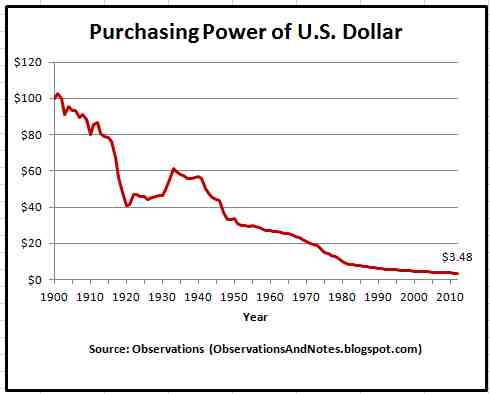
Your explanation doesn't make sense. If you actually do look at what happened with the inflationary dollar since the "late 19th century", it lost 96-97% of its purchasing power due to the monetary inflation.
Which means that if your grandma stored her wealth in dollars and wanted to pass it onto you, you can only enjoy 3-4% of what's left.
I was talking about the late 19th century. From 1860 to 1890, the USD gained roughly 50% in terms of purchasing power. Since the federal reserve got involved in open market operations in 1922 the USD has lost about 95% of its value.
Since 1928, the S&P has risen 5506%[1]. Over the same period, the dollar has lost 93% of its purchasing power. If you put a dollar on the market in 1928, it would be worth $808 (1928 dollars). A dollar under the mattress is instead worth $0.07 (1928 dollars). Investing had a return 11500-fold greater than hoarding cash.


Dogecoin could also become deflationary. If 6 billion dogecoins worth of value is created in a year and only 5 billion coins to match that increase in value, the economic value of goods created surpases that of the coins created. As a result, you have more goods chasing (relatively) fewer coins, increasing the value of the coin. In other words, less dogecoin gets you more stuff so you actually have (price) deflation.
In the US, during the stupidly-named "long depression" of the late 19th century, prices slowly dropped to about 60-65% of what they were at the start of the period while the total supply of money grew. That's because more goods were chasing (relatively) fewer gold-backed dollars. Monetary inflation coupled with price deflation.