It took them many months to get it on Android. It was wildly successful initially, and then it took many months to reach phones and missed much of the hype cycle. So I think it took them a lot of effort to port.
It's surprising given that back in June? 2024 I just extracted the .love zip from the executable, patched a file or two, and merged it into the love android apk and it Just Worked. Just goes to prove the last 5% rule
This. I'm making a game and I have an Android and iOS experimental branches. Even with a multiplatform framework (Monogame), compilation and basic run isn't a given. Then thing like small buttons needs biggee touch target, text input requires adaptation. All those 3 days + 1 day + a week + ... quickly adds up.
I've made games in Love2D for Android and for PC, I also as part of my converting Balatro to android, patched it a few places.
> Even with a multiplatform framework (Monogame), compilation and basic run isn't a given.
This isn't the case for Love2D. The game framework is already compiled for android, and the game is a bunch of Lua scripts. There is no issue with compiling, only very minor differences between the Lua for Android and the Lua for desktop platforms and making changes is instant except for transferring the apk to my phone and installing it to test (I didn't set up a full local android test environment for something so small). Balatro worked pretty much out of the box, except for some small changes I made — the first was to add in my profile from Steam, I didn't have to change the code for this. All the buttons were already reasonably sized. Text input was just adding a call to https://www.love2d.org/wiki/love.keyboard.setTextInput so that the on-screen keyboard appeared and disappeared when it was supposed to. I also patched a small bug that made it go blank on screen-reorientation, which was a one-line fix.
The total time spent was around an hour including codebase orientation, patching, testing and doc lookup (I haven't used the framework in a while).
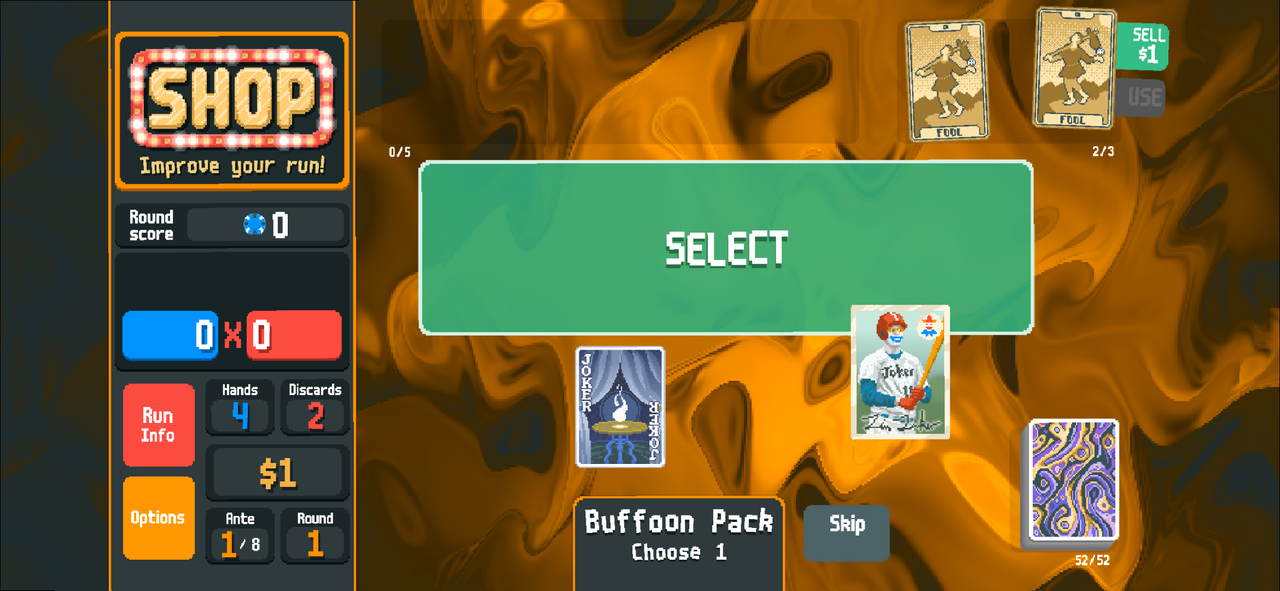
The desktop UI actually worked pretty much fine on mobile, to be honest. I ran it for a while using the porting methods available from the desktop binaries to an APK. The mobile UI basically just changes the interactions from a small button on the card to a drag-bases UI, which is slightly better on mobile.
The funny thing is that the original Desktop UI is still in the Android version. Sometimes I'll get jokers/consumables stuck in the desktop's "selected" mode, where the tiny sell/use buttons pop out underneath. So the whole drag-n-drop thing seems to have been added on top of the original ui, and sometimes the old ui events still fire.