Get better or quit then, I don't give a shit about managers, do your job and let the dozens of people you manage live their fucking lives, we're not here to please you or make your job easier
> we're not here to please you or make your job easier
I don't mean to be a jerk but ... if you are one of the people I manage, you literally are employed (at least in part) to make my job easier. That's not the only thing that matters -- which is why we (like many employers) do still allow some remote work. But making management more difficult is absolutely an impact that a rational workplace would take into account.
Your employees are there to make your life easier? As their manager? Do you demand they make you coffee? Rub your feet?
I've been doing this for decades, and I've never seen that attitude work with any 'leader.' I'd hate to work for you. Ever hear of servant leadership? Or hear the line "My job is to clear the runway for you"
Managers are cost centers, 'your' employees are what keep you employed, give them the respect they deserve.
That's not at all what I mean. What I mean is that I am responsible for the output of my team. If someone I am supervising does a bad job, is hard to communicate with, etc. it means that one way or another I have to do more work, which reduces the total output of my team. It can also lead to inferior service, angry clients, adverse outcomes, etc.
It’s the exact opposite, managers are employed to make employees job easier. Employees get the jobs done, managers are there to coordinate that work, remove blockers, and enable workers.
The relationship is reciprocal. I lay the tracks so my supervisees can do their job (and, indeed, have a job to do!). They help me produce far more work for clients than I ever could myself.
Though the truth is probably just that we're not seeing eye-to-eye because we're communicating through an imperfect medium that doesn't encourage a nuanced discussion.
> If AI produces surplus where does it go? Not talking about investment backed datacenter buildout and AI labs. Talking about the results of AI work...
The 1% pockets, this is where the vast majority of the extra productivity computers/internet/automation brought goes to for the last 50 years: https://www.epi.org/productivity-pay-gap/
The study doesn't say it went into the 1%'s pockets. It says it went to 2 places:
1) The salaries of corporate employees
2) Shareholders and capital owners
Regarding number 2: "Shareholders" would include anyone who owns any stock at all, including a lot of middle class people with a simple S&P 500 ETF in their portfolio.
And the increase in productivity allowed more people to become capital owners, AKA entrepreneurs. The explosion in software entrepreneurs, for example.
#2 only works if the public is allowed to invest when the new technology is in its early stages, which is currently not the case. Microsoft went public in 1986 at a valuation of $2.3 billion (in today's dollars). What's OpenAI / Anthropic going to be worth by the time they IPO? $1 trillion? $2 trillion?
> Regarding number 2: "Shareholders" would include anyone who owns any stock at all, including a lot of middle class people with a simple S&P 500 ETF in their portfolio.
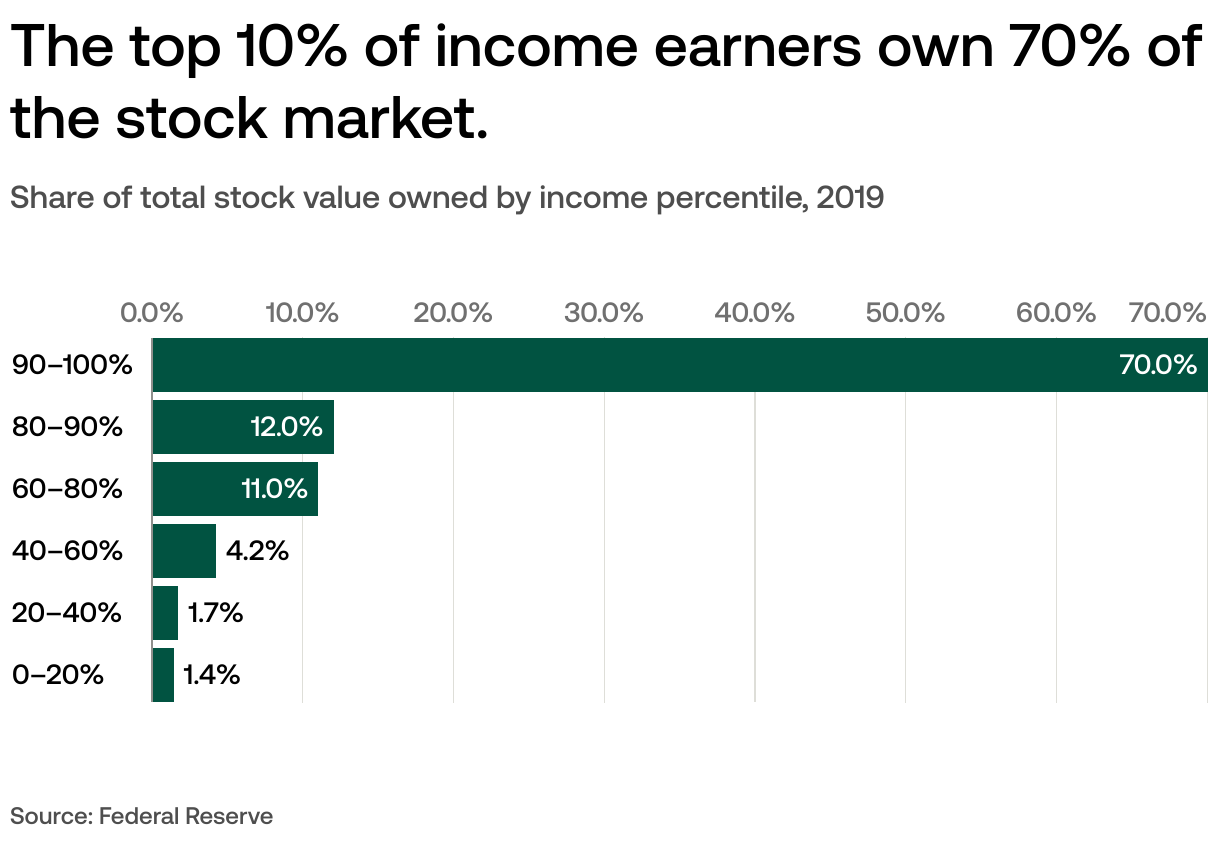
Yes, but shares are not at all uniformly distributed. Tim Cook owns 3.28 million shares of AAPL. For comparison, the 50 million Vanguard customers have to divide 1.3 billion shares amongst them, averaging about 26 shares of AAPL each.
> And the increase in productivity allowed more people to become capital owners, AKA entrepreneurs. The explosion in software entrepreneurs, for example.
The majority of those end up getting bought by larger software companies.
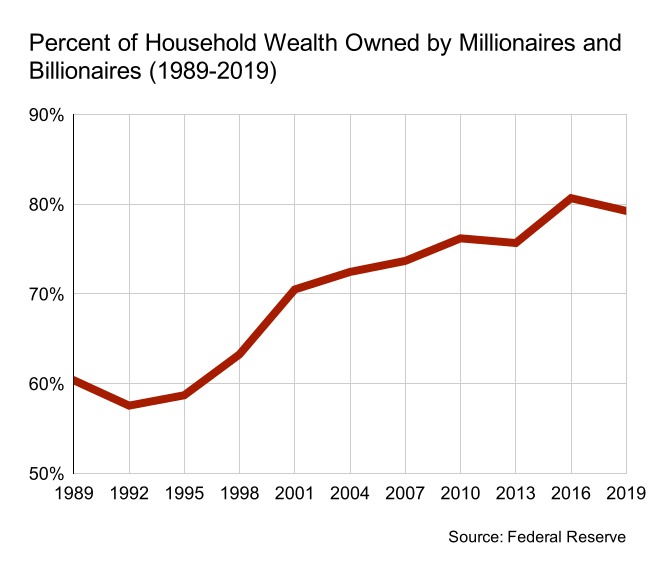
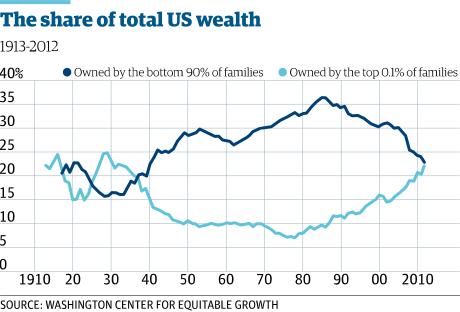
Overall capital ownership is increasingly concentrated among a small number of elites.
A good indicator that someone is simply being dogmatic and not arguing in good faith (e.g. actually trying to understand someone's POV, and being open to being proven wrong in their assumptions) is when it takes them 5-20 minutes to reply until a particularly good point is made and then they disappear into the ether.
I think getting into the weeds on whether $80k or $100k or $120k/yr is a middle class sort of misses the point, but at least with my eyes it is hard to argue you're middle class if you're making more than about $150k at the most.
Even the GP, which I directionally agree with, says "upper-middle class is people making ~$200k/yr" but you're deep into the top quintile by that point, probably top 10%. I don't know what percentile I consider "upper middle" but it's definitely lower than top 10%.
Most of this is in developing nations where people are expanding agriculture into wild areas rather than implementing innovations in more intensive agriculture. Developed nations are currently increasing forest cover and wild land. You're demonstrating the EXACT myopia I'm referring to.
Not at all. I'm arguing that the deployment of new processes and technology is uneven and takes time to permeate the global economy. You can see the progress in a lot of places, it's just not everywhere yet. Many countries are still operating the mid 20th century tech stack, or in many cases earlier iterations. There's a lot of work that could be done on clear land registries for example that would alleviate a lot of deforestation. Slash and burn agriculture doesn't happen in developed economies, and is a solvable problem.
I earn less than my grandparents adjusted for inflation (they quit school at 18, I have a master's degree in computer science), my peers can't afford housing anymore, people don't have kids because it's too expensive, I'm expected to retire 10+ years later than them too, and that's in western Europe where we got plenty of this "innovation" and "technology", weekly working hours are expected to go up, public services are decreasing in quality.
So what gives? Where is all the good stuff? Is it this new macbook I can buy for 599?
Yeah European welfare states fucked up by pinning retirement payouts to an assumption of a growing labor force, and doubly fucked up by shackling their energy needs to Russian gas. What you have in Europe are sclerotic states with declining capacity. Vote better.
> see smog and pollution from England Industrial revolution
I love how people keep using the "it was worse during the industrial evolution" argument as a gotcha for every environmental and societal issues... no shit my dude, really? even in the middle of the "dark ages" we didn't send 8 years old kids down mines for 10+ hours a day or make people work 12 to 16 hours a day, 6 days a week... WW2 era Poland was literally a better place to live in than England during the industrial revolution
They had 0 smog and 0 pollution before all these innovations, we had 200 years of insane innovations and smog/pollution is now consistently in the top 5 leading causes of deaths every single year, you scaled it from like 5 cities in England to the entire planet
Pollution is not in the "top 5 leading causes of death" unless you count all deaths caused by diseases that are exacerbated by pollution as caused by pollution.
> I love how people keep using the "it was worse during the industrial evolution" argument as a gotcha for every environmental and societal issue
Maybe you think I'm saying something I'm not.
> They had 0 smog and 0 pollution before all these innovations
That's not true. Man-made ecological disasters go back a long ways, but they did not scale up as much until the population growth exploded following the invention of ammonia and the industrial revolution. Until then, 80% of people worked the land. If you understand the reasons behind the deadly plagues that decimated numbers in middle-age Europe, it was clearly not pollution-free.
With technological progress, and policy, total emissions are falling in developed countries despite growing population. They were still growing rapidly in China until recent years where fossil fuel use has plateaued.
Now emissions are growing because other East Asian countries are getting rich, e.g. India, Vietnam. Fortunately they are not missing a beat taking advantage of renewables either.
I think culture and education play much bigger roles than anything else, all the sources I find show Germany and France having similar level of corruption (on top of being geographically and economically close) but completely different level of "social trust".
China's pretty corrupt politically but the social trust is quite high, the highest outside of northern europe as far as I can tell
The corruption numbers break down into: (1) They didn't ask the question in China, (2) They asked somebody if they paid a bribe or if taking a bribe is every justifiable, and (3) "Expert estimates of the extent to which the executive, legislative, judiciary, and bureaucracy engage in bribery and theft, and the making and implementation of laws are susceptible to corruption"
For (2) China doesn't look too different from the U.S., for (3) experts think it has gotten much worse since the time of Mao but I'd say China is on the honest side of the "global South".
Note that lay perceptions of corruption are widespread in the US
> though unlike India I think very few Americans have paid a bribe to a cop.
No one, left or right, thinks there is street level corruption. Not the kind accessible to someone in a traffic stop. I have experienced it in Mexico and think that kind of corruption would still be worse because I cannot imagine how to recover from it. I have hope that a few high profile arrests of c level fall his may turn the tide. If not then there are extrajudicial methods open to American culture.
I know from my own personal experience that I haven't paid a bribe to a cop or to an alderman to get a zoning variance. There are some places where this kind of thing is routine. (e.g. I know there is a crooked cop somewhere but I also believe that if I tried to pay a bribe to a cop it wouldn't go well)
Thus I trust people's reports of street level corruption.
If it comes to perceptions of "corruption in high places" that is mediated by the media. It may well be that it is very corrupt and you never hear about it, or that it squeaky clean but you hear allegations 10 times a day. Or a Democrat might think everything is corrupt when Republicans are in power and then when Democrats are in power, Republicans take up the slack.
So I don't trust people's reports of corruption in high places.
Now I know a lot of people who are involved in road construction and maintenance in upstate NY who range from "drives a truck" to "manages $10M+ projects" and the belief that there is corruption in highway projects is widespread based on second- and third- hand accounts.
There's an interesting paradox hiding in plain sight here: Xi imported the anticorruption strat from Singapore, so superficially, PH below is correct.
Since SG has the opposite problem from China: ((low) gov corruption XOR (low) social trust).
The paradox is that the strat will have wildly different failure modes in SG vs CN or JP (all are aware of this!)
Note also that SG is consistently ranked in the top 10 together with the Nordics+NZ+IE+CH in spite of this failure mode..
My informed opinion is that LDP+loyalist-bureaucrats have been shipping and failing the same strat for years-- LDP dominance is the tell. Any critique of Xi's policy can be backed with JP data. Prediction: Xi will succeed if and only if CPC fall (or do the ship-of-theseus thing)
It's the institutional part which is lacking in France. Look at the budget of the ministry of justice in France per capita and in Germany. Germany spend twice as much and has twice as much judges per capita than France (and everything which goes with it like clerks).
My company took the biggest telecom company in France to court for a violation of our license on a soft, license was GPLv2, we won, but it took 12 years.
Justice is a very poor and slow institution in France. For the same countries the budget of police forces per capita are nearly the same for example.
Also Germany spends more than France on defence while having a lot less to show for, with France having nuclear weapons, nuclear subs, aircraft carriers and a much more capable military overall with less money. Germany is the poster child of government waste. If I were a taxpayer there I'd want my money back and/or bureaucrats going to jail.
> China's pretty corrupt politically but the social trust is quite high, the highest outside of northern europe as far as I can tell
There are a few reasons for that that I can imagine:
- China is one of very few autocracies that has managed to significantly improve the standard of living of most of its population.
- The public trials and (sometimes) executions of allegedly corrupt individuals might help improve the perception of corruption.
- The same harsh penalties mentioned above might influence people to declare a higher level of social trust than they actually have, even if the poll is supposedly "confidential" and "only for scientific purposes".
Now define "members". It's both possible and common for an in-group to experience a high degree of trust and care, while those outside that group to... Not. From the point of view of the beneficiaries the social contract is working beautifully!
I found Singapore somewhat bracing in how honestly they acknowledge the two tiers (natives + wealthy foreigners vs poor "guest" workers) in their society. The same division functionally exists in many "western" countries, but is broadly ignored. (To be clear, I do not endorse this - and, in fact, think it appalling - but appreciate straightforwardness more than I do obfuscation by empty rhetoric.)
It's not like atrocities started with Nazis. Child prostitution, high unemployment, corruption, poverty, moral devastation, drug addiction, injustice, inequality ... all that existed before Nazis so many people ignored the warnings that came with the Nazi party since they were the only ones promising to act.
Something about this doesn’t sit right with me. I’m not a historian but something tells me not everyone else was a-ok with atrocities that existed before nazis.
Also, again I’m not a historian, but I believe their promise to act was also tied up in blaming others and hate.
“At least they got things done” is very often the seed around which a belief in fascism crystallizes.
They don’t deserve any recognition for what they promised or what they accomplished.
This is a thread about my definition of a high trust society.
So far the only argument in support of nazi germany being high trust is that they got shit done.
I don’t see how anyone could argue that imprisoning your own population in forced labor camps based on rumor is something that can happen in a high trust society.
There is no trust in such a society, only fear.
Arguing about this any more is making me feel sick.
My only claim was that things were far from perfect (profoundly broken) before Nazis came to power. They made many terrible things, but they also fixed some of the issues they promised to fix. That's why they were able to grab power.
You can read more about the Weimar Republic. If it weren't so fundamentally broken, Nazis would never come to power. Stating this is not Nazi apologia but a warning of what happens if governments and the ruling class ignore the will of their own people and actively work against it for a long time.
The original context of this thread is the validity of china’s data in this trust survey. Interjecting with positive example of nazi germany is not even correct. There’s no way anyone can argue in good faith that nazi germany was high trust.
The nazis don’t need you to come to their defense.
Nazism is basically ignoring the will of their own people and actively working against them.
You can’t honestly say that a country where citizens inform on each other and put each other in forced labor camps based on rumor is a society where trust is high.
> The Deutscherblick ("German Look") was a tense, habitual glance over the shoulder used by citizens in Nazi-era Germany before speaking about sensitive topics like food rations, Hitler jokes, or the war’s progress
Not just labor camps. People would regularly get beheaded for anti-regime remarks. Nazi justice was keen on capital punishment for relatively minor crimes.
Nazi Germany was full of dedicated informers who would even earn money or other privileges for denouncing someone. It had about as much trust between strangers as Iran under the Revolutionary Guards might have today.
China was getting better for a long time. XI is changing that. Change is slow though and he is not rushing corruption though it seems to be increasing. He has purged some corrupt people as well making things slightly better in the short term - but he values loyalty over competence and so his short term changes are for less corruption but long term increase it.
That is China is a complex country and books (which are not written and many cannot be for decades yet) are needed to understand this, not a short comment box. [This applies to every other country anyone here mentions]
Social trust is high because there are pretty heavy handed control measures over the population with havy costs. Thats more of a fear based society than trust. Government can giveth and government can taketh.
1. Fear of a capricious state can cause survival-motivated compliance which can appear as "trust" in coarse measurements. Meaning, you simply do fewer of those things that would provide opportunities for distrust in contexts where that could happen.
2. In a relatively severe, but consistent regime, the high penalties for violating trust in everyday cases (crime) act as a deterrent.
3. Fear may cause people to be selective and mindful about their social associations based on stronger proofs of trustworthiness. You might tell a Hitler joke to someone you have used more energy/caution to "vet", but avoid being too casual in environments of undetermined trustworthiness.
We are probably meant to assume ceteris paribus and only vary the dimension of corruption.
I think you’re right that culture plays a key role. For example if small bribes are customary, that doesn’t erode trust, that’s just the way things are.
Selling back to the grid, maybe. But if displacing your own use, 10p/kwh is a pipe dream in the UK, more like 25p+.
And my point is more that in that example price/kwh, the "best" location only returns $150 or so for that same system.
Sure, worth keeping in mind for payback calculations, but not really a "category change" - power prices vary more than that proportion between the countries involved. And certainly not the whole multiples a pure insolation chart might imply.
You don't need scientific arguments for everything you know. What's your argument against consentent 10 year old siblings having sex together if they use protection? I don't have one but I know it's morally wrong and won't bring anything good
> They also provide diplomatic cover and economic support for the Iranian regime
I can't believe some people can still argue in good faith the US and israel are the good guys, do you have a ounce of self reflection? You kidnap presidents, kill entire families of political leaders, talk about them like they are dogs (see the latest white house propaganda videos or Hegseth speeches), and then you come here to argue China is bad because they may one day plan to do something similar, how blind are you? Everything you accuse the others of planning you already have done it or are actively doing it right now...


reply